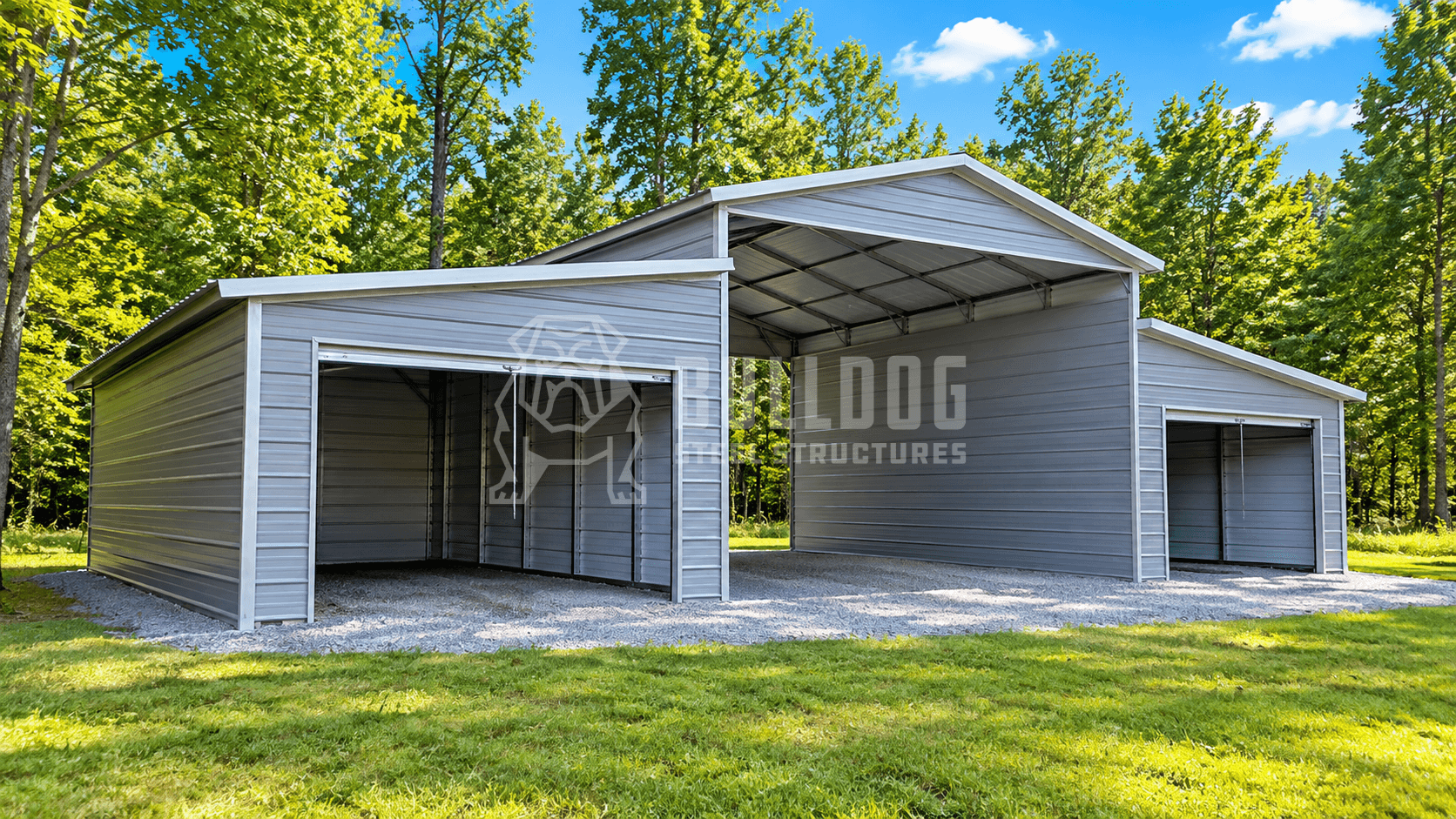
1. What is a Carolina barn?+
A Carolina barn is a three-section steel barn with a tall raised center and two matching lean-tos attached down both sides. The center is fully enclosed with gable ends, while the lean-tos can be open, partially closed, or fully enclosed depending on your configuration. The raised center improves ventilation, clearance, and water drainage, making this one of the most versatile metal barn styles available.
2. What sizes do Carolina barns come in?+
Standard Carolina barn sizes range from 36x20 to 48x35, with lengths available up to 51 feet. Common configurations include 36x20, 36x30, 42x35, 42x40, 44x20, 44x51, and 48x35. The center section is typically 12 to 24 feet wide depending on total width, and both lean-tos are usually 12 feet wide each. Lengths and heights can be customized to your needs.
3. What is the difference between a Carolina barn and an A-frame Carolina barn?+
The standard Carolina barn uses a vertical-roof raised center with vertical-roof lean-tos. The A-Frame Carolina barn uses an A-frame center with angled roof panels for a more traditional barn silhouette. Both work for the same uses, but A-frame styles tend to shed snow more efficiently and often look more like conventional barns.
4. Can the lean-tos on a Carolina barn be enclosed?+
Yes. Lean to metal barns can be specified as open, closed on one side, closed on both sides, or fully enclosed with walls, doors, and windows. Many buyers choose fully enclosed lean-tos for secure storage of equipment or feed, while keeping the center section for the main livestock or workshop use. Lean-tos can also be enclosed later after installation.
5. What foundation does a Carolina barn need?+
A Carolina barn can be installed on concrete, asphalt, or gravel. Gravel pads should be at least four inches deep, contained by a border, and extend slightly past the building's footprint. On gravel, the barn is fixed with auger anchors; on concrete, wedge anchors are used. Most buyers choose concrete for permanent installations, especially when the barn houses vehicles or workshops with heavy use.
6. Do I need a permit for a Carolina barn?+
Permit requirements vary by county. Most areas require a building permit for structures of this size, though some rural counties waive permits for agricultural-use buildings on qualifying acreage. Confirm your local requirements before ordering. Bulldog provides engineered drawings for permit submission as part of your order.
7. Can I buy a Carolina barn with no credit check?+
Yes. Rent-to-own programs let you buy a Carolina barn with no credit check, low monthly payments over 24 to 48 months, and no early payoff penalty. This is often the deciding factor for buyers at this size and price point because it removes the large upfront payment without requiring a credit application.
8. How long does it take to get a Carolina barn after ordering?+
Most Carolina barns are delivered and installed within 4 to 8 weeks of ordering, depending on your location, local permit requirements, and current manufacturing queue. On-site installation typically takes 2 to 5 days depending on size and configuration.
9. What colors are available for a Carolina barn?+
Bulldog offers 15+ standard colors for roof, walls, trim, and wainscot at no extra cost. Classic barn red is the most popular, but earth tones, grays, greens, and traditional farm colors are all available. The deluxe two-tone (wainscot) package adds a contrasting color on the lower walls for a more polished look.
10. Can a Carolina barn be used for horses or livestock?+
Yes. Carolina barns are very popular for equestrian and livestock use. The raised center section provides tall enclosed space for stalls or main living quarters, while the lean-tos serve as run-ins, tack rooms, hay storage, or additional stall space. Interior partitions can be specified at order to create stalls within the main structure.