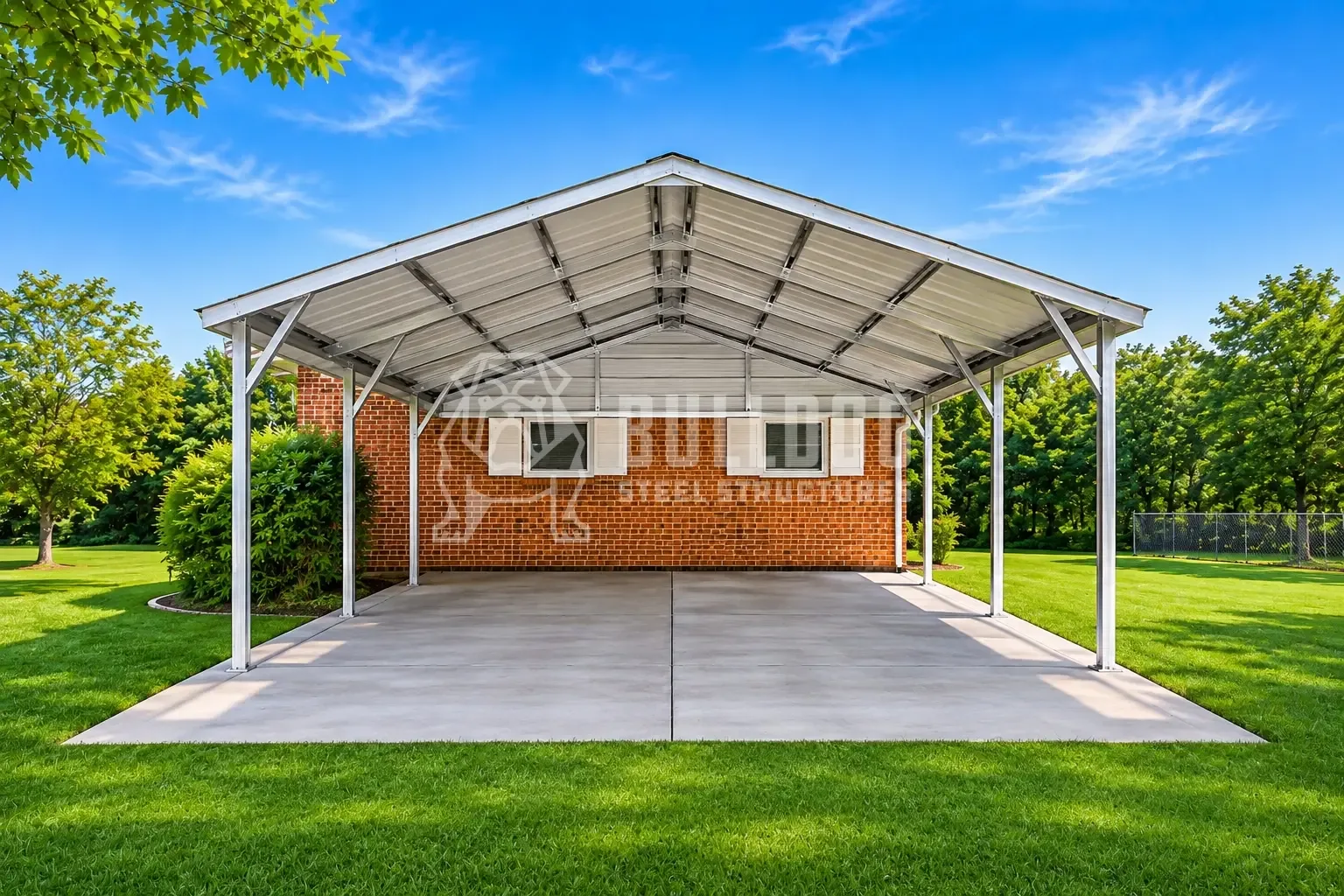
You've requested quotes from three carport manufacturers for what sounds like the same product — a 20×20 metal shelter for your two vehicles. Quote #1 comes in at $1,795. Quote #2 comes in at $2,695. Quote #3 comes in at $3,495. All three claim galvanized steel construction, all three include delivery, and all three use similar marketing language. So what's actually different? The honest answer: the $1,700 spread between those quotes reflects real specification differences that most buyers can't see on a quote sheet but will absolutely feel over 20-40 years of ownership. Steel gauge, eave height, engineering certification, panel grade, roof style, and 5 other factors each move the price meaningfully.
This guide walks through exactly what drives metal carport pricing — not to justify one price over another, but to help you compare quotes honestly. We'll cover the three big specification factors (gauge, height, certification) that most buyers get wrong, plus 5 additional factors that quietly add or subtract hundreds from quoted prices. By the end, you'll know whether that $1,795 quote is a genuine bargain or a bait-and-switch waiting to happen — and whether the $3,495 quote is honest value or inflated markup.
● Quick Answer
- Why prices vary ($1,195 to $8,995+ range): Eight specific factors drive the spread — steel gauge (framing and panels), eave height, engineering certification, roof style, enclosure level, door count, color/finish options, and regional delivery cost.
- The three biggest price movers: (1) Gauge upgrades (12-gauge framing +15%, 26-gauge panels +8%); (2) Eave height (10 ft adds $300-$600, 14 ft adds $1,500-$2,500); (3) Certification/engineering stamps (certified structures cost 10-20% more but qualify for permits and better insurance rates).
- Gauge explained: Steel gauge is a thickness measurement where LOWER numbers mean THICKER, stronger steel. 14-gauge framing is standard; 12-gauge is thicker and stronger (upgrade recommended for coastal/high-wind). 29-gauge panels are standard; 26-gauge is thicker (recommended for hail-prone areas).
- Certification explained: Certified carports come with stamped engineering drawings showing exact wind rating (90-170 mph) and snow load (20-50 psf). Required for most residential permits. Non-certified structures save ~10-20% but can't pass permit review in many jurisdictions.
- Regional pricing variation: The same configuration costs $200-$800 more in distant delivery zones due to shipping logistics. Within our 30+ state service area, delivery is included; outside it, custom quotes apply.
- What CHEAP quotes often hide: Lower-than-market quotes typically cut corners on gauge (lighter aluminum vs. galvanized steel), certification (no stamped drawings), permit support, or include bait-and-switch delivery/installation fees added later.
Bulldog Steel Structures quotes every carport with gauge, eave height, roof style and certification spelled out, with free delivery and installation. Call 888-551-2156 to price your carport for your ZIP code.
Steel Gauge: The Spec That Separates $1,500 Shelters from $3,000 Structures
Gauge is the thickness measurement for steel. It's counterintuitive to most buyers because the numbering system runs opposite to what intuition suggests — LOWER gauge numbers mean THICKER, stronger steel. A 12-gauge frame is thicker and heavier than a 14-gauge frame. A 26-gauge panel is thicker and more durable than a 29-gauge panel. This single specification accounts for more carport price variation than any other factor.
Framing Gauge: 14-Gauge Standard vs 12-Gauge Upgrade
The structural frame — the vertical posts, horizontal braces, and roof trusses — is where gauge matters most for long-term durability and weather resistance:
- 14-gauge galvanized steel framing (standard): Approximately 0.075-inch-thick steel. Industry-standard framing used in most residential carports. Carries a 10-year framing warranty. Adequate wind rating: 90- 115 mph in open-sided configurations. Suitable for most mild-climate residential installations.
- 12-gauge galvanized steel framing (upgrade): Approximately 0.105-inch thick steel — 40% thicker than 14-gauge. Carries a 20-year framing warranty (double). Significantly higher wind resistance when combined with a vertical roof (140-170 mph rated). Recommended for coastal properties, tornado-prone regions, high-wind areas, and buyers planning 20+ years of ownership.
- Price impact: 12-gauge upgrade typically adds 15% to shell cost. On a $2,195 base 20×20 carport, 12-gauge adds roughly $330. On larger structures, dollar impact scales proportionally.
- What cheap quotes do: Some competitors advertise "steel carport" pricing but deliver thinner 16-gauge framing (even lighter than standard 14-gauge). Others use aluminum framing dressed up as "metal." The difference shows up in warranty limitations, insurance challenges, and visible structural deflection within 5-10 years.
Panel Gauge: 29-Gauge Standard vs 26-Gauge Upgrade
The exterior panels — roof and walls — face different stresses than framing. Hail resistance, paint retention, and visual aesthetics all depend on panel thickness:
- 29-gauge painted steel panels (standard): Approximately 0.015 inches thick. Industry-standard panel thickness with a 20-year paint warranty. Adequate for most climates with moderate weather exposure. Shows minor hail damage from 1.5+ inch hail. Paint chalking visible after 15-20 years in UV-intense regions.
- 26-gauge painted steel panels (upgrade): Approximately 0.019 inch thick — 27% thicker than 29-gauge. Carries a 40-year paint warranty (double). Significantly better hail resistance. Paint retention extends to 25-30 years in most climates.
- Price impact: 26-gauge panel upgrade typically adds 8% to shell cost. On a $2,195 base carport, 26-gauge adds roughly $175.
- Where cheap quotes save money: Some competitors ship 30-gauge or even 31-gauge panels (lighter than standard 29-gauge) to hit lower price points. These thinner panels dent easily from hail, show paint fade faster, and often void warranty claims on severe-weather damage.
● The Honest Gauge Recommendation
For most mild-climate residential installations: 14-gauge framing + 29-gauge panels (standard) is adequate. For coastal, high-wind, or long-term ownership: upgrade to 12-gauge framing. For hail-prone regions or aesthetic-sensitive installations: upgrade to 26-gauge panels. Both upgrades combined add approximately 23% to shell cost but typically double warranty terms and dramatically improve 30-year total cost of ownership.
For dedicated 12-gauge configurations with full pricing, see our deluxe carports product line.
Eave Height: The Spec Most Buyers Default to Wrong
Eave height is the measurement from ground level to the lowest point of the roof edge. Standard 8 ft eaves are the base-price default, but they're inadequate for most buyers' actual vehicles. Eave height upgrades represent the second-biggest price variable after gauge:
| Eave Height | Price Adder | What It Supports |
|---|---|---|
| 8 ft (standard) | Baseline | Sedans, compact SUVs, bare pickups without roof racks or accessories |
| 9-10 ft | +$300-$600 | Full-size pickups with standard roof racks, SUVs with cargo carriers, workshop overhead storage. MOST-RECOMMENDED minimum. |
| 12 ft | +$800-$1,500 | Trucks with roof-mounted equipment, tractors with raised loaders, Class B/C RVs, boats with T-tops |
| 14 ft | +$1,500-$2,500 | Class A motorhomes, commercial box trucks, large agricultural equipment with implements raised |
| 16 ft+ | +$2,500-$4,500 | Commercial-scale equipment, semi-trucks, oversized agricultural equipment, aircraft |
● The Eave Height Trap
Many buyers order 8 ft eaves because it's the base price, then discover their truck with a roof rack doesn't clear, or their cargo carrier scrapes the eaves. Retrofitting taller eaves after construction costs $8,000-$25,000+ or requires complete rebuild. Upgrading from 8 ft to 10 ft at order time costs $300-$600. The cost gap is 10-20x — this is the single most-regretted carport specification.
Why Eave Height Costs What It Does
Taller eaves aren't just "more steel" — they require structurally different engineering. A 14 ft eave carport needs heavier columns, additional bracing, larger baseplates, and often a different foundation approach. Wind loading increases non-linearly with height, so engineering requirements scale faster than the simple height measurement suggests. This is why the $300-$600 adder for 10 ft becomes $1,500-$2,500 for 14 ft — not linear.
Certified vs Non-Certified Carports: What Engineering Stamps Actually Mean
This is the factor most buyers don't understand until they try to file a permit and get rejected. "Certified" carports come with stamped engineering drawings produced by a licensed structural engineer. "Non-certified" carports don't have those stamps. The difference affects permit approval, insurance coverage, and legal compliance:
What Certification Actually Includes
- Stamped engineering drawings: Official structural drawings showing exact dimensions, framing specifications, anchor details, and load ratings. Signed and stamped by a licensed professional engineer registered in your state.
- Wind rating certification: Specific maximum wind speed the structure is engineered to withstand (90, 115, 140, 170 mph are common ratings). Required for coastal and hurricane-prone jurisdictions.
- Snow load certification: Specific maximum snow weight the roof can support, measured in pounds per square foot (20, 30, 40, 50 psf are common). Required in snow-country jurisdictions.
- Anchor specification: Exact anchor type and depth required for your installation (concrete anchors, mobile-home anchors, ground stakes). Impacts installation methodology.
- Code compliance statement: Documentation that the structure meets International Building Code (IBC) requirements for your jurisdiction.
Where Certified vs Non-Certified Matters
- Permit filing: Residential jurisdictions typically require stamped engineering drawings for permit approval on carports over 200-400 sq ft. Without certification, your permit application gets rejected. You'd then have to pay an engineer $400-$1,500 to produce stamped drawings separately.
- Insurance coverage: Insurers increasingly require certification documentation for coverage. Non-certified structures may receive reduced coverage or outright denial on weather-damage claims.
- Resale and appraisal: Appraisers value certified structures at full replacement cost. Non-certified structures are discounted or valued at zero. Buyers' inspectors frequently identify non-certified structures as negotiation leverage.
- HOA compliance: Many HOAs require stamped engineering drawings for architectural review committee approval.
Also Read: Comparing Rent-to-Own vs. Traditional Purchase: Which is Better for Metal Buildings?
The Price Difference
Certified carports typically cost 10-20% more than non-certified equivalents. On a $2,195 base price, certification adds roughly $220-$440. This covers the engineering costs the manufacturer absorbs, the premium materials certified installations require (specific anchor hardware, framing specifications, panel thicknesses), and quality-control processes.
● The Honest Certification Recommendation
Buy certified. The 10-20% premium is dramatically cheaper than paying an engineer separately ($400-$1,500), facing permit rejection, losing insurance coverage, or discovering at resale that your structure has no appraised value. For most residential buyers, non-certified structures aren't a cost-savings choice — they're a cost-shifting choice that ends up more expensive once permits, insurance, and resale implications land. All Bulldog carports include stamped engineering drawings at no additional charge.
Five More Factors That Move Carport Pricing
Gauge, height, and certification are the three biggest price movers. Five additional factors each add $100-$2,500 to pricing depending on choices:
Factor 4: Enclosure Level
Open-sided carports (just a roof on posts) represent baseline pricing. Adding walls dramatically changes the price:
- Open-sided (baseline): No walls, maximum ventilation, lowest cost. Suitable for mild climates and basic vehicle coverage.
- Partially enclosed (+$300-$1,200): 1-3 walls added for selective weather blocking. Common upgrade for snow country or buyers wanting workshop shelter.
- Fully enclosed (+$1,500-$3,000): All 4 walls plus roll-up and walk-in doors. Essentially a garage. Required for security, climate control, or workshop use.
Factor 5: Roof Style
The roof style decision affects both pricing and long-term performance:
- Regular roof (baseline): Horizontal ribs, lower cost. 90-115 mph wind rating, 20 psf snow load. Suitable for mild climates.
- Vertical roof (+25%, typically $500-$1,500): Vertical ribs running top-to-bottom. 140-170 mph wind rating, 40-50 psf snow load. Required for snow country, hurricane coasts, and residential use.
Factor 6: Doors, Windows, and Openings
Each door and window represents additional cost and installation complexity:
- Standard roll-up door 9×7 or 9×8: Included in enclosed configurations. Additional doors add $495-$795 each.
- Oversized roll-up doors (12×12, 14×14, 16×16): +$495-$1,595 vs standard sizing. Required for RVs, trucks with equipment, commercial vehicles.
- Walk-in man doors: +$295-$495 each. Standard on enclosed configurations; optional on open-sided.
- Windows: +$95-$395 each depending on size. Vinyl sliders or glass block options available.
- Insulation: Factory-installed double-bubble reflective adds $0.50-$1 per sq ft. Batt insulation with vapor barrier adds $1.50-$3 per sq ft. Retrofit after construction is 2-4x more expensive.
Factor 7: Color and Trim Selection
Color choice doesn't affect baseline price, but specialty colors and trim options add cost:
- Standard 14 colors (included): Barn Red, Williamsburg White, Forest Green, Charcoal Gray, Navy Blue, Burgundy, Black, Galvalume, plus additional options. No upgrade cost.
- Specialty/custom colors: +$200- $ 500 for non-standard colors requiring special order.
- Two-tone combinations: Included at no extra cost — pick different roof and trim colors for visual interest.
- Wainscot (two-tone with lower contrast color): +$300-$800 for the two-tone installation.
- Decorative trim upgrades (cupolas, finials, wainscot panels): +$400-$2,500 depending on complexity.
Factor 8: Regional Delivery and Installation
Where you are affects your final delivered cost through logistics and regional engineering requirements:
- Within standard service area (30+ states): Free delivery and professional installation included in quoted prices.
- Extended delivery zones: Carports to certain remote locations add $200-$800 in delivery logistics.
- Regional engineering upgrades: Coastal zones (140+ mph wind) require 12-gauge framing + vertical roof + specific anchor systems. Snow country requires vertical roof + 40 psf snow load certification. These regional upgrades can add $500-$2,500 to quoted baseline pricing.
- Permit filing fees: Vary by jurisdiction. Buyer's responsibility, typically $100-$400. Our engineering drawings are included to support submission.
Price Reference: What Each Spec Combination Actually Costs
Specific pricing comparison showing how different specification choices affect final cost on the most popular 20×20 2-car carport configuration:
| Configuration | Starting Price | What You Get |
|---|---|---|
| 20×20 Open, Regular Roof, 14-gauge, 29-gauge, 8 ft eaves | $2,195 | Base spec, mild-climate residential |
| 20×20 Open, Vertical Roof, 14-gauge, 29-gauge, 8 ft eaves | $2,695 | +Vertical roof upgrade |
| 20×20 Open, Vertical Roof, 14-gauge, 29-gauge, 10 ft eaves | $3,095 | +10 ft eaves (recommended minimum) |
| 20×20 Open, Vertical Roof, 12-gauge, 26-gauge, 10 ft eaves | $3,595 | +Both gauge upgrades (coastal/long-term) |
| 20×20 Partially Enclosed, Vertical Roof, 12-gauge, 26-gauge, 10 ft eaves | $4,395 | +1-side enclosure |
| 20×20 Fully Enclosed with 1 Door, Vertical Roof, 12-gauge, 26-gauge, 10 ft eaves | $5,195 | +Full enclosure (essentially a garage) |
The $3,000 spread between the base $2,195 configuration and the $5,195 fully-upgraded configuration isn't marketing variation — it's real specification differences. The buyer getting "carport quotes" without understanding these factors often picks the cheapest option and gets surprised when the installation doesn't match expectations.
For complete carport pricing across all sizes and configurations, see our metal carport prices guide, or our dedicated 2-car metal carports product page for detailed 2-car pricing.
How to Honestly Compare Quotes from Different Manufacturers
Now that you understand what drives pricing, you can compare quotes apples-to-apples instead of being misled by cheap-looking numbers that hide corner-cutting. Follow this 5-step comparison process:
Step 1: Get Specification Details in Writing
Request that each quote include specific framing gauge (not just "steel"), panel gauge, roof style, eave height, anchor system, and engineering certification status. Verbal assurances aren't enough — written specifications protect you from bait-and-switch delivery.
Step 2: Normalize for Specification Differences
Put each quote on the same spec basis. If Quote #1 is 14-gauge framing and Quote #2 is 12-gauge, add 15% to Quote #1 for comparison. If Quote #1 is 8 ft eaves and Quote #2 is 10 ft, add $400 to Quote #1. If Quote #1 isn't certified and Quote #2 is, add $300-$500 to Quote #1. Only after normalization can you honestly compare.
Step 3: Verify Certification Status
Ask each manufacturer: "Does my quote include stamped engineering drawings for permit submission?" If yes, confirm which licensed engineer stamps them and in which states. If no, factor in $400-$1,500 for separate engineering work. This eliminates most "cheap" quotes that don't actually include certified structures.
Step 4: Confirm What's Included vs. Extra
Explicitly ask: "Is delivery included?", "Is professional installation included?", "Is the anchor hardware included?, "Are the engineering drawings included?".Some quote tactics: low shell price, high separate delivery/installation fees. Add all extras to compare actual delivered cost.
Step 5: Check Warranty Terms
Framing warranty: 10-year is standard for 14-gauge, 20-year for 12-gauge. Anything shorter signals lower-quality construction. Paint warranty: 20-year standard for 29-gauge, 40-year for 26-gauge. Compare warranty terms alongside pricing — a $300 cheaper quote with a 5-year warranty vs 20-year warranty isn't actually cheaper over ownership.
● The Honest Comparison Rule
After spec normalization, warranty comparison, and verification of included items, the real cost difference between reputable manufacturers typically shrinks to 5-15% — not the 50%+ spreads that raw quotes suggest. Massive price differences almost always indicate specification cuts rather than genuine value differences.
When a Cheap Quote Is Actually a Red Flag
Not every lower-priced quote is a bargain. These patterns signal corner-cutting or outright scams:
● Red Flags on Low-Priced Carport Quotes
(1) Vague specifications — "heavy-duty galvanized steel" without specific gauge numbers. (2) No certification/engineering drawings included. (3) Separate delivery fees not quoted upfront. (4) Insistence on same-day deposit or cash-only payment. (5) No written warranty terms. (6) Price jumps unexpectedly after order confirmation (bait-and-switch). (7) No permanent business address, only a phone number. (8) Can't name their licensed engineer or state registration. If a competitor's low price shows 2+ of these patterns, the price isn't a bargain — it's a trap.
Legitimate Reasons a Quote Can Actually Be Cheaper
Not every lower price is a scam. Some legitimate reasons quotes come in lower than market averages:
- Regional manufacturer with local logistics advantage: Manufacturers close to your delivery address have lower freight costs and can price accordingly. Verify by checking their service area map.
- Seasonal pricing (January-March): Winter orders typically run 3-8% below summer pricing due to lower demand and installation crew availability. Legitimate seasonal variation.
- Bulk/combination orders: If you're ordering multiple structures together (carport + storage shed, two carports), bulk pricing of 3-8% off is standard.
- Veteran/first responder discounts: Legitimate 3-5% discounts for military, first responders, teachers, healthcare workers. Should be clearly documented.
For honest discount guidance, see our discounts on metal buildings guide, which explains the 7 legitimate ways to save vs. the fake-urgency theater common in the industry.
How to Buy the Right Specs Without Overpaying
Understanding why prices vary lets you spend money on specs that matter for YOUR situation and skip specs that don't. The maximize-value approach:
Always Spend Money On These
- Certification: The 10-20% premium prevents permit, insurance, and resale problems that cost 5-10x more than the certification upgrade.
- Appropriate eave height: If you have trucks or SUVs with any accessories, spend the $300-$600 for 10 ft eaves. Retrofit cost is 10-20x this amount.
- Vertical roof in severe-weather regions: If you're in snow country, hurricane coast, or tornado-prone area, the 25% upgrade pays back in a single avoided weather damage event.
Spend Money On These If Long-Term Ownership
- 12-gauge framing: If you're planning 15+ years of ownership, the 15% upgrade doubles warranty and improves structural capacity meaningfully.
- 26-gauge panels: In hail-prone regions or for aesthetic-sensitive installations, the 8% upgrade doubles paint warranty.
- Factory insulation: If there is any possibility of climate-controlled use, factory insulation is 50-60% cheaper than retrofit.
Skip These Unless You Actually Need Them
- Oversized eaves beyond your actual vehicle needs: 14 ft eaves for a sedan is wasted money. Match eave height to your tallest actual vehicle + 1-2 ft.
- Specialty colors: Standard 14-color palette is free. Specialty colors ($200-$500 upgrade) rarely add resale value.
- Decorative trim: Cupolas and decorative accents look nice but add cost without functional benefit. Skip unless aesthetics are the primary purchase driver.
- Oversized sizing beyond actual needs: A 22×26 "for future flexibility" when you only ever use 20×20 is wasted money. Oversize moderately; don't oversize wildly.
Frequently Asked Questions
Why do metal carport prices vary so much?
Eight specific factors drive the $1,195-$8,995+ spread: steel gauge (framing and panels), eave height, engineering certification, roof style (regular vs vertical), enclosure level (open vs partially enclosed vs fully enclosed), door count, color/finish selection, and regional delivery costs. The three biggest movers are gauge upgrades (adds 15-23%), eave height upgrades (adds $300-$2,500), and certification (adds 10-20%). Massive price differences between quotes usually reflect specification differences, not marketing variation.
What does 'certified' mean for a metal carport?
Certified carports come with stamped engineering drawings produced by a licensed structural engineer. The drawings specify exact wind rating (90-170 mph), snow load (20-50 psf), anchor requirements, and code compliance. Required for most residential permits above 200-400 sq ft. Required for appraisal at full value. Required for insurance coverage in most cases. Non-certified structures save 10-20% upfront but typically cost more overall because buyers either face permit rejection or pay $400-$1,500 for separate engineering.
What's the difference between 29-gauge and 26-gauge panels?
Panel gauge measures the thickness of the exterior roof and wall panels. 29-gauge standard panels are approximately 0.015 inches thick with a 20-year paint warranty. 26-gauge upgrade panels are approximately 0.019 inches thick (27% thicker) with a 40-year paint warranty. 26-gauge dramatically improves hail resistance and paint retention. Upgrade typically adds 8% to shell cost — approximately $175 on a $2,195 base carport. Recommended for hail-prone regions and long-term ownership.
How much does eave height add to carport price?
Default 8 ft eaves are baseline pricing. 10 ft eaves add $300-$600 (recommended minimum for most buyers with trucks/SUVs). 12 ft eaves add $800-$1,500 (trucks with roof equipment, Class B/C RVs). 14 ft eaves add $1,500-$2,500 (Class A RVs, commercial vehicles). 16+ ft eaves add $2,500-$4,500 (commercial/industrial). Taller eaves require structurally different engineering, not just more steel — pricing scales non-linearly with height.
Do I need a certified carport to pass a permit?
In most residential jurisdictions, yes. Carports over 200-400 sq ft typically require stamped engineering drawings for permit approval. Without certification, you'd face permit rejection (and either need to buy a certified structure or pay $400-$1,500 for separate engineering work after the fact). Agricultural zones often exempt smaller structures from permit requirements, but even there, certification provides insurance and resale value. Bulldog includes stamped engineering drawings with every order at no additional charge.
Are cheaper metal carports always worse quality?
Not always, but usually yes. Legitimate reasons a quote can be lower: regional manufacturer with local logistics advantage, seasonal pricing (January-March), bulk order discounts, veteran/first responder discounts. Common illegitimate reasons: lighter gauge framing (16-gauge instead of 14-gauge), lighter panels (30-gauge instead of 29-gauge), no certification included, hidden delivery/installation fees added later. If a quote is 30%+ below market average, assume specification cuts rather than genuine savings.
Should I upgrade to 12-gauge framing?
Depends on your situation. YES if: coastal property (wind exposure), hurricane coast, tornado-prone region, long-term ownership plans (15+ years), or planning any future residential use. NO (14-gauge is fine) if: mild climate, basic vehicle storage only, shorter-term ownership, budget-constrained. 12-gauge upgrade adds 15% to shell cost — $330 on a $2,195 base. The upgrade typically pays back in insurance savings and resale value for coastal/high-wind buyers.
What's the single most-regretted carport specification?
Eave height. Buyers overwhelmingly report wishing they'd ordered 10+ ft eaves instead of the 8 ft default. The symptom: truck with roof rack doesn't clear, cargo carrier scrapes the roof, SUV with roof box can't enter. The fix at order: $300-$600 upgrade. The retrofit cost after construction: $8,000-$25,000+. This is the single highest-ROI spec decision to get right at order time.
Do all manufacturers include delivery and installation in quoted prices?
No — this is a common pricing-comparison trap. Some manufacturers quote low shell prices with separate delivery charges ($400-$1,200 depending on distance) and separate installation fees ($300-$800) added after order commitment. Always ask explicitly: "Does this quote include delivery to my ZIP code AND professional installation on my prepared pad?" Bulldog includes both at no additional charge throughout our 30+ state service area.
What's the price difference between regular roof and vertical roof?
Vertical roof upgrade typically adds 25% to shell cost — approximately $500-$1,500 on standard residential carports depending on size. Regular roof is baseline pricing and provides 90-115 mph wind rating with 20 psf snow load (adequate for mild climates). Vertical roof provides 140-170 mph wind rating with 40-50 psf snow load (required for snow country, hurricane coasts, and residential use). For most buyers in severe-weather regions, the upgrade pays back in a single avoided weather damage event.
How much do walls cost on an enclosed carport?
Depends on enclosure level. Partial enclosure (1-3 walls) adds $300-$1,200 to the open-sided baseline. Full enclosure (all 4 walls + doors) adds $1,500-$3,000. Each roll-up door is $495-$1,195 depending on size. Each walk-in man door is $295-$495. The total gap between an open-sided and fully enclosed carport is typically $1,800-$4,200 on residential sizes. For buyers wanting security, climate control, or workshop use, enclosure is worth the cost.
Do metal carport prices go up or down over time?
Steel commodity pricing fluctuates with market conditions, but structural metal carport prices have been relatively stable over 2020-2026, varying ±5-10% year-over-year. Current 2026 pricing reflects normal market conditions. Seasonal variation (3-8% lower in January-March) is more significant than year-over-year drift. The main factor driving long-term pricing is steel commodity costs; secondary factors are labor availability and manufacturing capacity. Buyers waiting "for prices to drop" rarely benefit — ordering during January-March seasonal low beats waiting indefinitely.
What warranty should I expect on a quality metal carport?
Framing warranty: 10 years on 14-gauge (standard) or 20 years on 12-gauge upgrade. Paint warranty: 20 years on 29-gauge (standard) or 40 years on 26-gauge upgrade. Expected practical lifespan with basic maintenance: 40-50+ years. Anything with a shorter warranty signals lower-quality construction — 5-year framing warranties, for example, indicate lighter-gauge steel. Quality manufacturers stand behind their structures with industry-standard warranty terms.
Should I buy from a local manufacturer or a national company?
Depends on your situation. Local/regional manufacturers often have logistics cost advantages for buyers in their service area — they can price competitively because freight is shorter. National companies have a broader service area and more consistent specifications. Decision factors: (1) Where is your delivery address relative to each manufacturer's facility? (2) Does each include certification, delivery, and installation? (3) What are warranty terms? (4) Are stamped engineering drawings for your state included? Compare on these specifics rather than "local vs national" generally.
Get an Honest Quote You Can Actually Understand
Metal carport pricing doesn't have to feel like decoding a foreign language. When you understand what drives price variation — gauge, height, certification, and the 5 other factors — you can compare quotes honestly and spend money on specs that matter for your specific situation.
Free Honest Quote in 15 Minutes Share your ZIP code, intended use, and configuration preferences. We'll quote with specification details explicit (gauge, height, certification, roof style, enclosure, color) so you can compare apples-to-apples to other quotes. Free delivery and professional installation included throughout our 30+ state service area. Stamped engineering drawings included at no charge. Rent-to-own available with no credit check. Call 888-551-2156. |
What Our Customers Are Saying
I'm really happy with the way my building turned out! Due to living in city limits I had to make changes to my original plan but working with Bryan made it easy. He was great to work with!
Bulldog Steel Structures is fantastic. We had a 24'x40' garage built with two 10' garage doors, an entry door, two windows and fully insulated for under $16,000. The whole experience was so easy. Our salesman was Bryan Valadez. Bryan was so helpful and was easily available to answer my questions. Rebekah Aldridge handled all the documents and signing of them. The whole process was great. The building is well constructed and the crew that erected it were courteous and cleaned the worksite afterwords thoroughly. They did an excellent job in a time efficient period. Our experience with Bulldog Steel Structures was just great and we highly recommend them.
I'm in early stages, just put deposit on building. I reviewed about 10 quotes and worked with many vendors in the space to assess. Constance from Bulldog Steel Structures made the experience fabulous and was key in our decision making. It's so refreshing to see a company like this have such outstanding client facing service. We are excited and huge shout out to Constance and the team. Bravo!
I have purchased two structures/buildings from them and have been greatly satisfied. From "idea to implementation" it has gone smoothly. I love the idea of having one single point of contact (Noah) for any questions or concerns. The install crew comes in and gets right to work and the quality is the best I have seen. Highly Recommend!
I worked with Bryan Valadez in putting together my bids for a 2000 SF shop/garage. He was great to work with, very quick to respond and answered all my questions and concerns during several very thorough conversations regarding my project. I recommend you give Bulldog a shot when searching for your next building, their pricing was very good compared with some of the others, and they just seemed to have it very together for their process. Great Job, thanks Bryan. Jason
Showed up on time and excellent quality. Could not be more pleased with the results!
I called and spoke to Bryan. With some back and forth he helped me finalize the design (40x100 foot print). I placed my order and had to wait for my King County building permit to be issued. Once the slab was completed the installation team arrived with all the pieces. They got right to work and the building was completed in 8 days !!! I would highly recommend Bryan and Bulldog to any one :) Many thanks john in the pacific northwest
Great company to do business with. Would recommend them to others.
Great to deal with. Building went up with no problems.
I had a great experience with Bulldog Steel Buildings. The representatives were able to help me move from the online design to an actual building design to meet my goals. They set up the delivery and installation which turned out great. Installation was scheduled quickly after the foundation was done; and the building was completed within 2 days. Pricing was reasonable, and I'm very pleased with my new building.
Bryan was great- honest, helpful, responsive and knowledgeable. I will call him if I ever need another steel building
This company is the real deal. They go over and beyond to satisfy their customers. It is a joy to work with them. They are very knowledgeable and efficient. I looked forward to finishing my project with them.
Humberto was very responsive and it was a pleasure to work with. He went above and beyond to get delivery scheduled as soon as possible for our 30x50 building. Great company to work with.
Hey folks - these people at Bulldog are real. Noah helped me all the way through - extremely patient and knowledgeable. He answers most often and when he doesn't it's easy to get another HUMAN to speak with. I looked at several companies for this project - I settled on the right one. If you wind up doing business with Brian - you're in luck there to. Outstanding work - worthy of trust.
I purchased a 26x32 Garage from Bulldog Steel Structures they had it finished in two days. It looks really nice and the install crew was great. I’m thinking of getting another building and I will definitely contact Bryan Valadez again at Bulldog.
Great experience from start to finish. The sales process was easy and Casey helped me revise my plans several times to get the right building for my needs. Communication was excellent! The build crew was on time, friendly and professional. Beto took the time to understand what cutouts I needed and why I needed them in the sizes planned. Exceptional work. Highly recommend. Thank you!
I would recommend Bulldog Steel Structures highly. They are very professional and accommodating. Want to give special thanks to Randall Hall and also matt preslar. They were very accommodating and helping me fill out paperwork and handling things when a timely basis. The building we were very satisfied with and the installers also were very polite and had things done on a timely basis. Thanks again Randall and Matt you`ve got my five star rating
Bulldog has been great to work with. They explained everything from beginning to end. I live in the mountains of New Mexico and the staff made sure that my garage had the right support needed for this area of the country. I would highly recommend them for anyone building a new carport or gaeage!
Good design tool on their website. Great customer service.
Have had nothing but a positive experience with Bulldog! Bryan was super helpful and still is after our install! He still responds super prompt and helpful. No complaints about our structure, as it looks amazing! Installers did a great job and picked up very nicely after they were done. Highly recommend!!
I have now had my building in place for 3 months and I want to say that the whole team at Bulldog was very helpful throughout the entire process. My salesperson, Matthew, was extremely responsive. He was very helpful with the design phase, where we went back and forth with 3-4 different designs before settling on the perfect one. He always got back to me right away when I had a question. Although the delivery was delayed, understandable with the pandemic, he helped interface with Carolina Carports when I had delivery questions. So far I have no issues with the completed building. No leaks and all the doors are functioning perfectly. I would highly recommend using Bulldog for all your metal building needs.
Frank Rangel was very helpful and respectful. Also very understanding. I was pouring a concrete driveway and trying to put my down payment down. I may of got a little frustrated in the middle of it all. I could see the smile on Frank`s face the whole time! Thank you sir!
This is my second building from bulldog and I`m buying the same building , just different colors. They are great buildings that are strong and economical.
Excellent customer service during my order process, answered all my questions and they were very patient.
The website was very flexible and helped me customize my carport. The Bulldog staff was very prompt and helpful throughout the process.
Put up a RV cover for me on a concrete pad. Turned out great and the guys cleaned up after the work. Very satisfied. Would recommend these people.
I love my “She Shop.” It was amazingly easy. I sent an email, made 2 phones calls and it was done. The installation went even easier. Three guys showed up one day and finished the next. They were polite and cleaned up after themselves. My husband’s friends are all very impressed with the construction and materials used but were amazed at the reasonable price. I could not be more pleased. Thank you
I visited their website and used the 3D estimator and was able to see my building with doors, window placements, colors,and overall look. When you add or change any feature, including size, you can immediately see the result and change in price (if any). You can rotate the structure to see the overall look and framework. Once I placed my order, it was quickly and efficiently handled and the cost was lower than the estimate on the website The installers showed up early one morning and by noon the next day they had completed the structure. Everyone that comes by remarks on how nice it looks. I am very pleased with every aspect from ordering to installation.
Delivering & installing throughout the United States
Bulldog’s metal barns, garages, and carports are available for delivery and installation in most of the U.S. Whether you’re a homeowner in Maine, a rancher in Texas, or a small business owner in California, you’ll get to-your-door delivery and professional installation, so your building will be sturdy and reliable for years to come.