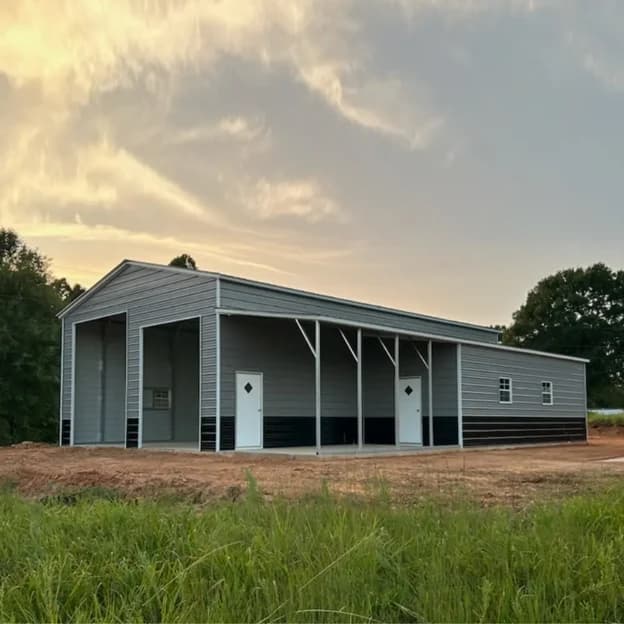
In much of the country you don’t get a free choice of roof style. Your county’s published snow load and design wind speed, your building’s length, and your local hail risk narrow the field before personal preference enters it. Vertical roofs shed snow, water and debris because the panels run ridge to eave; regular and A-frame roofs run panels horizontally and cost less, which makes them a reasonable choice only for small open structures in mild, dry, low-wind areas.
Most people choose a roof style the way they choose a paint colour — by looking at photos until one feels right. Then the first heavy winter arrives, and they find out that three feet of wet snow doesn’t care what looked good in the brochure.
Understanding why the code narrows your options saves you from either overbuying a roof you’ll never need or, far worse, underbuying one that fails an inspection or a storm.
This guide covers what each roof style actually does, the four weather forces that should drive the decision, and where every state falls.
Get a Roof Style Matched to Your County. See roof styles, framing gauges and certifications priced for your snow load and wind speed. |
The Three Roof Styles, and What Physically Differs
Forget the marketing descriptions. The meaningful difference is which direction the panels run, because that determines how water and snow leave the roof.
Regular roof. Panels run horizontally, across the width of the metal building, with rounded corners at the eaves. Snow and water have to travel sideways across the ribs rather than straight down. It’s the least expensive option and the fastest to install, and it’s genuinely fine for small open structures in mild, dry climates.
A-frame (boxed eave) roof. Panels still run horizontally, but the roofline is a true peak with squared-off eaves and trim. The squared eave adds rigidity, and it looks more like a house — which matters if the building sits near one. Water sheds better than a regular roof, but the panels are still fighting the same sideways travel.
Vertical roof. Panels run from the ridge down to the eave, with raised ribs between them channelling everything straight off the roof. Gravity works with the panel orientation instead of across it. This is the only one of the three that sheds snow, water and debris the way a residential metal roof does, and it’s the one that pairs with the heavier framing and additional bracing used in certified high-load buildings.
That single difference — panel direction — explains nearly everything that follows.
The Four Forces That Should Decide Your Roof
Snow Load
Snow load is measured in pounds per square foot of ground snow, and it’s a real engineering number your county publishes. It ranges from essentially zero along the Gulf Coast to well past 100 psf in mountain areas.
Snow’s danger isn’t the storm; it’s the sitting. Snow that stays on a roof for three weeks, partially melts, refreezes and gets snowed on again can weigh several times what it did when it landed. Horizontal panels give it ledges to sit on. Vertical panels let it slide before it accumulates.
If your ground snow load is above roughly 20–30 psf, treat a vertical roof as the default and make anyone who suggests otherwise justify it.
Wind Uplift
Wind doesn’t push a roof down. It flows over the top, creates low pressure above the panels, and tries to peel them upward — which is why roofs fail at the edges and corners first, not in the middle.
Two things resist that: how the panels are fastened and seamed, and how many anchors transfer the load into the ground. Vertical panels with raised seams give wind less to grab. A boxed eave helps by closing off the edge where uplift starts.
Worth knowing: the wind rating a metal building dealer quotes and the design wind speed in your building code are not the same scale. Code figures come from ASCE 7 and are ultimate design speeds; industry ratings are often stated differently. Don’t assume a 90 mph building satisfies a 90 mph code requirement. Ask your specialist to confirm the building meets your county’s stated figure specifically.
Hail
The most under-discussed factor in this whole category. Hail damage claims are concentrated in a corridor running from Texas up through Colorado, Kansas, Nebraska and the Dakotas — and in much of that region hail is a more frequent cause of roof damage than snow or wind.
Panel gauge matters more than roof style for hail resistance, but style still contributes: vertical panels with raised ribs distribute impact across a stiffer profile than flat horizontal panels spanning between supports. If you’re in hail country, ask about gauge and roof style together rather than treating them as separate decisions.
Moisture and Corrosion
Constant rain, high humidity and coastal salt air all attack the same weak point — anywhere water can sit. Standing water on a roof finds fastener penetrations and panel laps and works on them for years.
Vertical seams drain faster and leave fewer places for water to pool. In the Pacific Northwest, the Gulf Coast, and anywhere within a few miles of salt water, this alone is a strong argument for vertical.
The Rule That Overrides All of This
Most manufacturers require a vertical roof once a building passes a certain length, typically somewhere in the 30-to-40-foot range, because horizontal panels come in fixed lengths and lapping them across a long roof creates too many seams for water to exploit.
So if you’re building anything longer than a two-car garage, the decision may already be made for you regardless of your climate. This is the single most common surprise buyers hit, and it’s worth asking about before you spend time comparing styles.
Roof Style by State
Snow loads and wind speeds vary within states — a Colorado buyer at 9,000 feet faces different numbers than one in Pueblo, and coastal Texas differs sharply from the Panhandle. Use this as a starting point, then confirm your specific figures with your county.
| State | Primary weather driver | Recommended roof |
|---|---|---|
| Alabama | Humidity, tornadoes, coastal wind south | Vertical |
| Alaska | Extreme snow load | Vertical |
| Arizona | UV and heat, monsoon downpours | Regular or A-frame |
| Arkansas | Tornadoes, hail, humidity | Vertical |
| California | Varies: coastal salt, inland heat, Sierra snow | A-frame inland, vertical in mountains |
| Colorado | Heavy snow at elevation, severe hail | Vertical |
| Connecticut | Snow load, nor’easter wind | Vertical |
| Delaware | Coastal wind, moderate snow | A-frame or vertical |
| Florida | Hurricane wind, driving rain, salt air | Vertical, certified |
| Georgia | Humidity, tornadoes, coastal wind south | A-frame inland, vertical coastal |
| Hawaii | Salt air, high wind, heavy rain | Vertical |
| Idaho | Snow load, mountain wind | Vertical |
| Illinois | Snow, wind, hail | Vertical |
| Indiana | Snow, tornadoes | Vertical |
| Iowa | Snow, derecho wind, hail | Vertical |
| Kansas | Tornadoes, severe hail | Vertical |
| Kentucky | Ice, tornadoes, humidity | Vertical |
| Louisiana | Hurricanes, extreme humidity, salt air | Vertical, certified |
| Maine | Very heavy snow, coastal wind | Vertical |
| Maryland | Mixed snow, coastal wind east | A-frame or vertical |
| Massachusetts | Heavy snow, nor’easters | Vertical |
| Michigan | Lake-effect snow | Vertical |
| Minnesota | Extreme snow load | Vertical |
| Mississippi | Hurricanes, humidity, tornadoes | Vertical |
| Missouri | Ice, tornadoes, hail | Vertical |
| Montana | Deep snow, high wind at elevation | Vertical |
| Nebraska | Snow, tornadoes, severe hail | Vertical |
| Nevada | UV and heat, snow in the north | Regular or A-frame south, vertical north |
| New Hampshire | Very heavy snow | Vertical |
| New Jersey | Coastal wind, moderate snow | Vertical |
| New Mexico | UV and heat, snow at elevation | A-frame low, vertical mountains |
| New York | Heavy snow, lake-effect upstate | Vertical |
| North Carolina | Mixed: mountain snow west, hurricanes east | Vertical |
| North Dakota | Extreme snow, sustained wind | Vertical |
| Ohio | Snow, lake-effect north | Vertical |
| Oklahoma | Tornadoes, severe hail | Vertical |
| Oregon | Persistent rain, mountain snow | Vertical |
| Pennsylvania | Snow load, ice | Vertical |
| Rhode Island | Coastal wind, snow | Vertical |
| South Carolina | Hurricanes, humidity | A-frame inland, vertical coastal |
| South Dakota | Snow, wind, hail | Vertical |
| Tennessee | Ice, tornadoes, humidity | Vertical |
| Texas | Varies: hurricanes on the coast, hail in the north, heat in the west | Vertical, certified in coast and hail belt |
| Utah | Snow at elevation, UV in the south | Vertical north, A-frame south |
| Vermont | Very heavy snow | Vertical |
| Virginia | Mixed snow, coastal wind east | A-frame or vertical |
| Washington | Persistent rain, Cascade snow | Vertical |
| West Virginia | Snow, ice, mountain wind | Vertical |
| Wisconsin | Heavy snow, lake-effect | Vertical |
| Wyoming | Deep snow, extreme sustained wind | Vertical |
If it looks like vertical dominates the table, that’s not a sales pitch — it’s what happens when you weight the decision by worst-case weather rather than average weather. A regular roof is a legitimate, sensible choice for a small open carport in a dry, low-wind area. It is not a good choice for an enclosed building you plan to keep for thirty years in a state with real winters.
Also read: 9 Ways to Combine a Carport and Garage on One Property.
Design Your Building in 3D Try regular, A-frame and vertical roofs against different sizes, colours and leg heights before you commit. |
Quick Comparison
| Regular | A-Frame / Boxed Eave | Vertical | |
|---|---|---|---|
| Snow shedding | Poor to fair | Fair | Excellent |
| Wind uplift resistance | Fair | Good | Excellent |
| Hail performance | Fair | Fair to good | Good |
| Drainage and corrosion resistance | Fair | Good | Excellent |
| Relative cost | Lowest | Middle | Highest |
| Best for | Small open structures, mild dry climates | Moderate climates, residential appearance | Snow, wind, hail, long buildings, long-term ownership |
How to Get Your Actual Numbers
Call your county or city building department and ask for two things: the design wind speed and the ground snow load for your address. Both come directly from the adopted building code; they’ll have them on hand, and the call takes five minutes.
While you’re on the phone, ask two follow-ups: whether your structure needs a permit at the size you’re planning, and whether they require engineer-certified, stamped drawings. Those answers shape your engineering and your budget more than any style decision.
Then give those figures to your building specialist before you finalise anything. A quote built on the wrong numbers is worse than no quote.
Four Mistakes That Cost People Money
- Buying for average weather. A roof earns its keep in the worst year, not the typical one. Plan for the heaviest snow and strongest wind your area has actually recorded.
- Assuming a rating matches a code number. Industry wind ratings and code design speeds use different scales. Confirm compliance explicitly rather than comparing the numbers yourself.
- Treating the roof as a place to save. Cutting eave height or leaving a side open saves real money. Downgrading the roof on a building that needs the upgrade saves a few hundred dollars against a structure you’ll own for decades.
- Ignoring what’s underneath. A vertical roof over a building with too few anchors, or the wrong anchor type for the surface, doesn’t perform to its rating. Roof style, framing gauge and anchoring are one system, not three separate choices.
Frequently Asked Questions
Which metal roof style is best for heavy snow?
Vertical. Panels running ridge to eave let snow slide off before it accumulates, while horizontal panels give it ledges to sit on. In any area with a ground snow load above roughly 20–30 psf, vertical should be your default.
Is a vertical roof worth the extra cost?
In snow, high-wind, hail or coastal regions, yes — it’s the difference between a roof that lasts decades and one that needs attention after every bad winter. For a small open carport in a dry, mild, low-wind area, a regular roof is a reasonable way to save money.
What roof style is best for hurricane areas?
A vertical roof on a certified building engineered to your county’s design wind speed, with the full anchor pattern the engineering specifies. The certification and anchoring matter as much as the panel direction.
Can I change my roof style after the building is installed?
Not practically. Roof style is tied to the framing and the engineering, so it’s a design-stage decision, not an upgrade you add later. Get it right the first time.
Do I need a vertical roof on a long building?
Often yes, regardless of climate. Most manufacturers require vertical panels past a certain building length because lapping horizontal panels across a long roof creates too many seams. Ask your specialist where that threshold falls for your design.
How do I find my local snow load and wind speed?
Call your county or city building department and ask for the ground snow load and design wind speed for your address. Both come from the adopted building code, and they’ll have them available.
The Bottom Line
There’s no roof style that wins everywhere, and any guide claiming otherwise is selling something. What there is, in almost every county in the country, is a published snow load and a published wind speed that narrow your options before taste enters the picture.
Get those two numbers first. The rest of the decision gets much simpler afterward.
At Bulldog Steel Structures, every building is engineered to the climate and code where it’s going, and our specialists will match the roof style, framing gauge and anchoring to your county’s requirements before you order.
Design Your Building in 3D or Get a Free Quote. Match the roof style, framing gauge and anchoring to your county’s requirements — or talk it through with a building specialist. Call 888-551-2156. |
What Our Customers Are Saying
I'm really happy with the way my building turned out! Due to living in city limits I had to make changes to my original plan but working with Bryan made it easy. He was great to work with!
Corey Evans
Bulldog Steel Structures is fantastic. We had a 24'x40' garage built with two 10' garage doors, an entry door, two windows and fully insulated for under $16,000. The whole experience was so easy. Our salesman was Bryan Valadez. Bryan was so helpful and was easily available to answer my questions. Rebekah Aldridge handled all the documents and signing of them. The whole process was great. The building is well constructed and the crew that erected it were courteous and cleaned the worksite afterwords thoroughly. They did an excellent job in a time efficient period. Our experience with Bulldog Steel Structures was just great and we highly recommend them.
Mattie Roberts
I'm in early stages, just put deposit on building. I reviewed about 10 quotes and worked with many vendors in the space to assess. Constance from Bulldog Steel Structures made the experience fabulous and was key in our decision making. It's so refreshing to see a company like this have such outstanding client facing service. We are excited and huge shout out to Constance and the team. Bravo!
Max Escuder
I have purchased two structures/buildings from them and have been greatly satisfied. From "idea to implementation" it has gone smoothly. I love the idea of having one single point of contact (Noah) for any questions or concerns. The install crew comes in and gets right to work and the quality is the best I have seen. Highly Recommend!
Ron Barnes
I worked with Bryan Valadez in putting together my bids for a 2000 SF shop/garage. He was great to work with, very quick to respond and answered all my questions and concerns during several very thorough conversations regarding my project. I recommend you give Bulldog a shot when searching for your next building, their pricing was very good compared with some of the others, and they just seemed to have it very together for their process. Great Job, thanks Bryan. Jason
Jason Ford
Showed up on time and excellent quality. Could not be more pleased with the results!
Drew Hood
I called and spoke to Bryan. With some back and forth he helped me finalize the design (40x100 foot print). I placed my order and had to wait for my King County building permit to be issued. Once the slab was completed the installation team arrived with all the pieces. They got right to work and the building was completed in 8 days !!! I would highly recommend Bryan and Bulldog to any one :) Many thanks john in the pacific northwest
John Marcus
Great company to do business with. Would recommend them to others.
Webster Smith
Great to deal with. Building went up with no problems.
Florida Chapter POCI
I had a great experience with Bulldog Steel Buildings. The representatives were able to help me move from the online design to an actual building design to meet my goals. They set up the delivery and installation which turned out great. Installation was scheduled quickly after the foundation was done; and the building was completed within 2 days. Pricing was reasonable, and I'm very pleased with my new building.
David Grover
Bryan was great- honest, helpful, responsive and knowledgeable. I will call him if I ever need another steel building
Allan Brown
This company is the real deal. They go over and beyond to satisfy their customers. It is a joy to work with them. They are very knowledgeable and efficient. I looked forward to finishing my project with them.
David Thomas
Humberto was very responsive and it was a pleasure to work with. He went above and beyond to get delivery scheduled as soon as possible for our 30x50 building. Great company to work with.
Kelly Heckel
Hey folks - these people at Bulldog are real. Noah helped me all the way through - extremely patient and knowledgeable. He answers most often and when he doesn't it's easy to get another HUMAN to speak with. I looked at several companies for this project - I settled on the right one. If you wind up doing business with Brian - you're in luck there to. Outstanding work - worthy of trust.
Randall Drew
I purchased a 26x32 Garage from Bulldog Steel Structures they had it finished in two days. It looks really nice and the install crew was great. I’m thinking of getting another building and I will definitely contact Bryan Valadez again at Bulldog.
Kris Phillips
Great experience from start to finish. The sales process was easy and Casey helped me revise my plans several times to get the right building for my needs. Communication was excellent! The build crew was on time, friendly and professional. Beto took the time to understand what cutouts I needed and why I needed them in the sizes planned. Exceptional work. Highly recommend. Thank you!
Damon Trim
I would recommend Bulldog Steel Structures highly. They are very professional and accommodating. Want to give special thanks to Randall Hall and also matt preslar. They were very accommodating and helping me fill out paperwork and handling things when a timely basis. The building we were very satisfied with and the installers also were very polite and had things done on a timely basis. Thanks again Randall and Matt you`ve got my five star rating
Shirley M.
Bulldog has been great to work with. They explained everything from beginning to end. I live in the mountains of New Mexico and the staff made sure that my garage had the right support needed for this area of the country. I would highly recommend them for anyone building a new carport or gaeage!
Bruce J.
Good design tool on their website. Great customer service.
John S.
Have had nothing but a positive experience with Bulldog! Bryan was super helpful and still is after our install! He still responds super prompt and helpful. No complaints about our structure, as it looks amazing! Installers did a great job and picked up very nicely after they were done. Highly recommend!!
Kristie S.
I have now had my building in place for 3 months and I want to say that the whole team at Bulldog was very helpful throughout the entire process. My salesperson, Matthew, was extremely responsive. He was very helpful with the design phase, where we went back and forth with 3-4 different designs before settling on the perfect one. He always got back to me right away when I had a question. Although the delivery was delayed, understandable with the pandemic, he helped interface with Carolina Carports when I had delivery questions. So far I have no issues with the completed building. No leaks and all the doors are functioning perfectly. I would highly recommend using Bulldog for all your metal building needs.
Mike W.
Frank Rangel was very helpful and respectful. Also very understanding. I was pouring a concrete driveway and trying to put my down payment down. I may of got a little frustrated in the middle of it all. I could see the smile on Frank`s face the whole time! Thank you sir!
Jason M.
This is my second building from bulldog and I`m buying the same building , just different colors. They are great buildings that are strong and economical.
Parke H.
Excellent customer service during my order process, answered all my questions and they were very patient.
Jack D.
The website was very flexible and helped me customize my carport. The Bulldog staff was very prompt and helpful throughout the process.
Dale & Karen W.
Put up a RV cover for me on a concrete pad. Turned out great and the guys cleaned up after the work. Very satisfied. Would recommend these people.
Dan and Linda I.
I love my “She Shop.” It was amazingly easy. I sent an email, made 2 phones calls and it was done. The installation went even easier. Three guys showed up one day and finished the next. They were polite and cleaned up after themselves. My husband’s friends are all very impressed with the construction and materials used but were amazed at the reasonable price. I could not be more pleased. Thank you
DTheressa J.
I visited their website and used the 3D estimator and was able to see my building with doors, window placements, colors,and overall look. When you add or change any feature, including size, you can immediately see the result and change in price (if any). You can rotate the structure to see the overall look and framework. Once I placed my order, it was quickly and efficiently handled and the cost was lower than the estimate on the website The installers showed up early one morning and by noon the next day they had completed the structure. Everyone that comes by remarks on how nice it looks. I am very pleased with every aspect from ordering to installation.
David T.
Delivering & installing throughout the United States
Bulldog’s metal barns, garages, and carports are available for delivery and installation in most of the U.S. Whether you’re a homeowner in Maine, a rancher in Texas, or a small business owner in California, you’ll get to-your-door delivery and professional installation, so your building will be sturdy and reliable for years to come.