How Does Rent-To-Own Work for Metal Buildings? A Complete 2026 Guide
Buying a metal building outright can run anywhere from a few thousand dollars for a small carport to tens of thousands for a fully customized commercial building. For most people, writing one check for the whole amount simply isn’t realistic, and traditional financing can be slow, paperwork-heavy, and tough to qualify for if your credit score isn’t perfect.
That’s where rent-to-own comes in. Rent-to-own (often shortened to RTO) lets you take delivery of a brand-new metal building with a small upfront payment, no credit check, and a straightforward monthly payment plan, then own the building outright once it’s paid off.
In this guide, we’ll walk you through exactly how rent-to-own works for metal buildings in 2026: the step-by-step process, who qualifies, what factors affect your monthly payment, what happens if you miss a payment, and how RTO stacks up against traditional financing and paying cash.
What Is Rent-To-Own for Metal Buildings?
Rent-to-own is a payment program that bridges the gap between paying cash up front and getting a traditional loan. Instead of borrowing money from a bank to buy your metal building, you enter into a rental agreement with an RTO partner (such as RTO National, Heartland, or EZPay) who purchases the building from your dealer and rents it to you under terms that lead to eventual ownership.
Each month, you make a payment. After your final scheduled payment, ownership of the building transfers to you. If you want to own the building sooner, you can pay it off early at any time, usually with significant savings compared to riding out the full term.
How Rent-To-Own Differs From a Loan
A traditional loan involves a lender (bank or credit union) that runs your credit, approves you based on your score and debt-to-income ratio, and lends you the money to buy the building. You then make monthly loan payments with interest until the loan is paid off.
Rent-to-own is structurally different. There’s no loan, no interest rate in the traditional sense, and no credit check. The RTO partner technically owns the building during the payment period, and you’re renting it with the option to own. This makes approval far easier and faster than getting a bank loan, though it usually costs more in total than financing or paying cash.
How Rent-To-Own Differs From Leasing
Leasing typically means you make payments to use something, but never own it at the end. Rent-to-own is different: ownership transfers to you automatically when the term is complete. You’re not just renting, you’re working toward ownership from day one.
How Rent-To-Own Works: The 5-Step Process
Here’s exactly what happens from the moment you decide you want a metal building to the moment you own it free and clear.
Step 1: Choose Your Building and Customize It
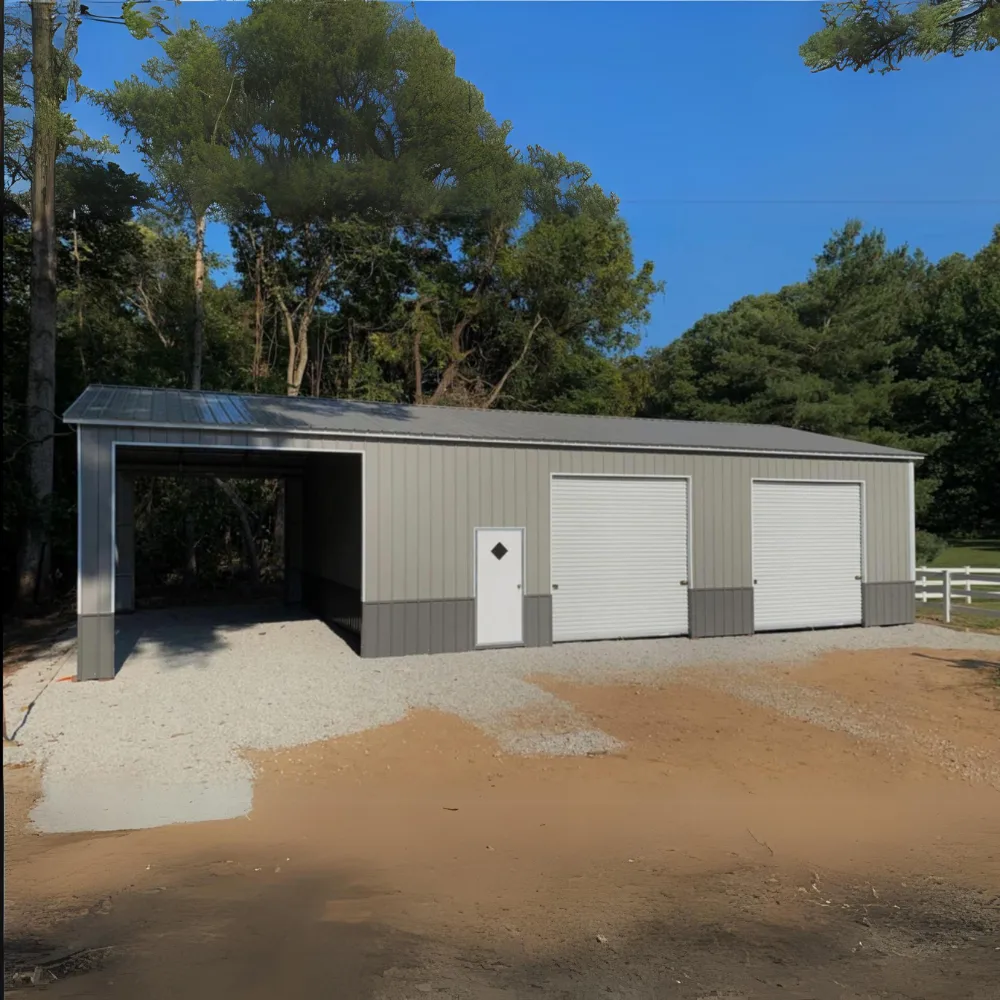
Start by picking the type of building you need: a Metal garages, carport, barn, workshop, or custom commercial structure. Then customize it: size, roof style (regular, A-frame, or vertical), color, doors, windows, insulation, and any add-ons. Many dealers, including Bulldog Steel Structures, offer a 3D estimator that lets you visualize your building and see exactly what you’re getting before you commit.
This is also the right time to confirm that rent-to-own is available in your state. RTO partners operate in most U.S. states, but there are a handful of restrictions to be aware of (more on that below).
Step 2: Submit Your RTO Application (No Credit Check)
Once you’ve designed your building, you submit a rent-to-own application. The form is short; most applications take 10 to 15 minutes, and it doesn’t require a credit check. Instead, you’ll typically provide:
- Your full name and contact information
- A valid government-issued ID
- Proof of income (recent pay stubs, tax returns, or bank statements)
- The delivery address where the building will be installed
- Confirmation that you own the property or have permission from the landowner
Step 3: Get Approved (Often Same Day)
RTO approvals are notoriously fast compared to bank loans. Most applications receive a decision the same day, with many approved within a couple of hours during business hours. The RTO partner is looking at income stability and ability to pay, not your credit score, so even buyers who have been turned down by lenders frequently get approved here.
Once approved, you’ll receive the full terms of your rent-to-own agreement: the first-month payment, the monthly payment amount, the term length, and the total amount you’ll pay over the life of the agreement. Read every line. If anything is unclear, ask before signing.
Step 4: Pay Your First Month and Schedule Delivery
After signing the agreement, you make your first month’s payment (sometimes called the ‘initial payment’ or ‘down payment,’ it’s the same concept). This locks in your order. Your dealer then schedules manufacturing and delivery.
Delivery timing varies by building size and your state. A simple carport or small garage may be delivered in 2 to 3 weeks. Larger or more customized buildings can take 4 to 6 weeks or longer during busy seasons. Your dealer will give you a specific delivery window once your order is in production.
Step 5: Make Monthly Payments Until You Own It
After delivery and installation, your monthly payments begin on a regular schedule (typically the same day each month). You continue paying for the length of the term, usually 36, 48, or 60 months. When the final payment clears, ownership of the building transfers to you, and the rent-to-own agreement is complete.
Throughout the term, you have full use of your building. You can store vehicles in it, run a business out of it, use it as a workshop, anything you’d do if you’d paid cash. The only thing the RTO agreement restricts is permanently modifying the structure or moving it without notifying the RTO partner.
Who Qualifies for Rent-To-Own?
One of the biggest advantages of rent-to-own is that the eligibility bar is much lower than traditional financing. Here’s what RTO partners typically look at:
No Minimum Credit Score Required
This is the headline feature. RTO partners don’t run a credit check, so your credit score, even if it’s poor, limited, or nonexistent, doesn’t disqualify you. People who have been declined by banks, who have past bankruptcies, who are rebuilding credit, or who simply don’t want a hard inquiry on their report are all welcome.
Income Verification
In place of a credit check, RTO partners verify that you have enough steady income to comfortably make the monthly payment. The exact income requirements vary by partner and by the size of the building you’re renting or owning, but typically you’ll need to show monthly income at least 2.5 to 3 times the proposed monthly payment. Pay stubs, tax returns, Social Security or disability statements, and bank statements are all accepted forms of proof.
Valid Government ID
You’ll need to provide a state-issued driver’s license, state ID, or passport. The address on file should generally match where you live or where the building will be delivered.
Property Where the Building Will Go
You either need to own the property where your metal building will be installed, or you need written permission from the landowner. The RTO partner needs to know they can deliver, install, and (worst case) retrieve the building if something goes wrong. If you’re renting, your landlord typically needs to sign off.
State Availability
Rent-to-own is available in most U.S. states, but a handful have regulations that limit or prohibit certain RTO agreements. As of 2026, RTO programs commonly operate across the Southeast, Midwest, Mid-Atlantic, and most of the Plains states. A few Northeastern and West Coast states have stricter rules. Always check with your dealer before assuming RTO is available in your state.
What Determines Your Monthly Payment?
Your monthly rent-to-own payment isn’t a flat number; it’s calculated based on several factors specific to your build. Understanding what drives the payment helps you make smart trade-offs when designing your building.
Building Size and Specifications
This is the biggest factor. A 12×20 single carport will have a much smaller monthly payment than a 40×60 fully-enclosed commercial garage. Bigger buildings cost more to manufacture, deliver, and install, and that’s reflected in your monthly payment.
Add-Ons and Upgrades
Every customization adds to the total cost: insulation, walk-in doors, garage doors, windows, gable ends, taller side walls, heavier-gauge steel, vertical roof style, and color upgrades. Each one has a clear cost, and your dealer will show you the impact on your monthly payment as you add features.
Term Length
RTO agreements typically run 36 months (3 years), 48 months (4 years), or 60 months (5 years). Longer terms mean lower monthly payments but a higher total amount paid over the life of the agreement. Shorter terms mean higher monthly payments but less total cost. There’s no universally ‘right’ term length; it depends on your budget and how quickly you want to own the building.
First-Month Payment
A larger first-month (down) payment reduces the amount being financed through the RTO agreement, which lowers your monthly payments. Some buyers put down the minimum to preserve cash; others put down more to reduce monthly outlay.
State
Different states have different RTO partner availability, different sales tax rules, and different delivery costs. Two identical buildings going to two different states can have meaningfully different monthly payments.
Can You Pay Off Rent-To-Own Early?
Yes, and this is one of the most underrated features of rent-to-own. There’s no penalty for paying off your agreement early, and doing so can save you a significant amount compared to riding out the full term.
90-Day Same-as-Cash Option
Most RTO partners offer a 90-day same-as-cash buyout. If you pay off the full remaining balance within the first 90 days of your agreement, you pay only the cash price of the building plus any sales tax, no RTO markup at all. This is hands-down the best value option if you can swing it. Buyers who want the speed and easy approval of RTO but don’t want to pay the long-term markup often use this approach: get approved fast, take delivery, then pay it off within 90 days.
Buyout Anytime
After the 90-day window, you can still buy out your agreement at any point. The buyout amount is the remaining balance minus a discount that grows the earlier you pay. For example, paying off at month 12 of a 60-month agreement will cost noticeably less than letting all 60 payments run through. Your RTO partner can give you the exact buyout amount at any time, just call and ask.
Why Early Payoff Saves Money
RTO is more expensive than paying cash because of the markup built into the monthly payments. The longer the term runs, the more you pay in total. Cutting the term short, even by a year, meaningfully reduces what you pay overall. If your financial situation improves during the agreement (raise, tax refund, sold a vehicle), putting that windfall toward an early payoff is usually a smart move.
Rent-To-Own vs Traditional Financing vs Cash
Each payment method has its own strengths. Here’s how they compare across the factors that matter most to most buyers:
|
Factor |
Rent-To-Own |
Traditional Financing |
Paying Cash |
|---|---|---|---|
|
Credit check required? |
No |
Yes (often hard inquiry) |
No |
|
Minimum credit score |
None |
Typically 600–680+ |
N/A |
|
Down payment |
Low (one month upfront) |
Often, 10–20% of the price |
Full amount |
|
Approval time |
Same day to 24 hours |
1–2 weeks |
Instant |
|
Time to delivery |
2–6 weeks |
3–6 weeks (loan + build) |
2–6 weeks |
|
Total cost vs cash price |
Highest |
Middle (cash + interest) |
Lowest |
|
Ownership during the term |
RTO partner owns; you use it |
You own (lender has lien) |
You own outright |
|
Effect on credit score |
None |
Hard inquiry + monthly reporting |
None |
|
Early payoff penalty |
No |
Sometimes |
N/A |
|
Best for… |
Limited/no credit, fast approval |
Good credit, lowest financing cost |
Anyone with the full amount |
There’s no objectively ‘best’ option; it depends on your situation. If you have great credit and time to wait, financing usually costs less than RTO. If you have the cash on hand, paying cash is always cheapest. But if you need a building soon and don’t want to deal with credit checks, slow approvals, or large down payments, rent-to-own is hard to beat.
What Types of Metal Buildings Are Available for Rent-To-Own?
Just about every type of metal building can be rent-to-owned, though the rules vary slightly by partner and state.
Metal Garages
Single-car, two-car, three-car, and larger garages are all RTO-eligible. Enclosed metal garages are the most popular RTO category; they offer secure vehicle storage, workshop space, and protection from the elements at a fraction of the cost of stick-built construction.
Carports
Open-sided carports are typically the most affordable RTO option because they’re the simplest structures. They protect vehicles, RVs, boats, and equipment from the sun and rain without the cost of a full enclosure.
Metal Barns
Including agricultural barns, horse barns, hay barns, livestock shelters, and Carolina-style barns. RTO works well for farmers and ranchers who need barn capacity quickly but want to spread the cost over time.
Workshops and Custom Buildings
Workshop buildings, fully-enclosed custom shops, and combination buildings (like a garage with an attached lean-to) are all RTO-eligible. Customization options inside the RTO program are typically the same as for cash buyers.
Commercial Metal Buildings
Many commercial structures qualify for RTO, too, though the maximum building price cap varies by RTO partner. If you’re looking at a very large commercial structure, ask your dealer which partner has the highest cap available in your state.
How to Get Started With Rent-To-Own
Ready to begin? Here’s the simplest way to get from ‘thinking about it’ to ‘building installed and in use’:
1. Browse and Configure Your Building
Start by looking at the buildings you’re interested in. If you know exactly what you want, jump straight to the size you have in mind. If you’re not sure, use a 3D estimator to play with sizes, layouts, and add-ons until you find something that fits your needs and your space.
2. Request a Free Quote
Once you’ve configured your building, request a free quote. This is a no-obligation step; you’re just asking for the numbers. The quote should include the cash price, the rent-to-own first-month payment, monthly payment amounts at 36/48/60 month terms, and the total amount you’d pay across the life of the agreement at each term.
3. Apply for Rent-To-Own
If the numbers work for you, apply for RTO. The application is short, online, and doesn’t require a credit check. You’ll typically receive a decision the same day.
4. Sign and Schedule
After approval, you’ll sign your RTO agreement and pay your first month. Your dealer then schedules manufacturing and delivery, and your installation team handles the rest.
Frequently Asked Questions
Do I own the building from day one?
During the rent-to-own term, the RTO partner technically owns the building, and you’re renting it with an option to own. Ownership transfers to you when the final payment is made (or when you pay off the agreement early). That said, you have full use of the building from the day it’s delivered; you can use it exactly as if you owned it.
What if I move during the rent-to-own term?
Metal buildings can be disassembled and relocated, but you need to notify your RTO partner before moving the building. They may need to update your agreement to reflect the new delivery address (especially if it’s in a different state). Don’t move the building without permission, which can put your agreement in default.
Can I customize my building during the RTO period?
Cosmetic changes like painting, adding shelving inside, or hanging tools are generally fine. Structural modifications, cutting new doors, removing walls, attaching the building to other structures, typically require written approval from your RTO partner because they affect the value of the building, which they technically own.
Do I pay property tax on a rent-to-own building?
Property tax rules vary by state and county. In some areas, metal buildings on a permanent foundation are taxed as real property. In others, they’re considered personal property and taxed differently or not at all. Check with your local tax assessor for specifics. Either way, you (the user/eventual owner) are typically responsible for any taxes, not the RTO partner.
Can I add insurance to my rent-to-own building?
Yes, and you should. Some RTO agreements require it. Even when not required, ensuring your metal building protects your investment from storms, fire, theft, and vandalism. Many homeowners’ insurance policies can be extended to cover detached structures; if yours can’t, a separate policy is usually inexpensive.
What happens if the building gets damaged?
If damage is caused by weather or accident, your insurance handles the repair. If the building has a manufacturing defect, your dealer’s warranty (typically 10–20 years on the structure) covers it. The RTO agreement itself doesn’t change your responsibilities; you maintain the building during the term the same way you would if you owned it.
Is there a maximum building price for rent-to-own?
Yes, and it varies by RTO partner. Caps typically range from around $20,000 on the low end up to $50,000 or more for larger commercial-grade RTO programs. If your dream build exceeds the cap of one partner, your dealer can often route you to a different partner with a higher cap.
Can I get rent-to-own delivered to my state?
Most states are covered, but availability varies by RTO partner. Always confirm with your dealer before assuming RTO is available where you live. If one partner doesn’t service your state, another might.
Does rent-to-own affect my credit score?
No. RTO partners don’t run hard credit inquiries, and they don’t report your payments to the credit bureaus. This is a double-edged sword: it means RTO doesn’t hurt your credit, but it also means on-time RTO payments don’t help build credit the way a traditional loan would.
Can I have an existing concrete foundation, or does the dealer install one?
Either approach works. Some buyers pour their own concrete pad before delivery; others have the building installed on bare ground or gravel and pour concrete later. Talk to your dealer about ground pre. They can advise based on your building, your soil, and your local codes.
What if I change my mind after signing?
Most agreements have a short cancellation window (often around 3 business days) where you can back out without penalty. After that window closes, canceling typically means forfeiting your first-month payment. Read your specific agreement for the exact cancellation terms.
Can I split payments biweekly instead of monthly?
Some RTO partners offer biweekly payment options, which can help align payments with biweekly paychecks. Ask your dealer or the RTO partner directly; not all offer this, but it’s worth checking.
The Bottom Line
Rent-to-own is one of the easiest and fastest ways to get a metal building when paying cash isn’t realistic and traditional financing isn’t an option. It trades a small amount of long-term cost for huge gains in approval speed, flexibility, and accessibility, which makes it the right choice for a lot of buyers, especially those with limited credit history, those who need a building urgently, or those who simply want to preserve cash for other things.
Like any payment program, rent-to-own works best when you go in with eyes open. Understand the monthly payment, the total cost over your full term, and the early payoff options. Pick a term that fits your budget without straining it. Communicate proactively with your RTO partner if anything changes. Do those three things, and rent-to-own becomes a powerful tool for getting the metal building you need without waiting years to save up cash or jumping through the hoops of a bank loan.
If you’re ready to see what rent-to-own would look like for your specific building, the next step is simple: design what you want, request a free quote, and review the numbers. There’s no commitment until you decide to apply.
delivering & installing
throughout
the united states
Bulldog’s metal barns, garages, and carports are available for delivery and installation in most of the U.S. Whether you’re a homeowner in Maine, a rancher in Texas, or a small business owner in California, you’ll get to-your-door delivery and professional installation, so your building will be sturdy and reliable for years to come.
See Service Area