Metal Barn vs Pole Barn: The Honest Comparison Guide for 2026
By Bulldog Steel Structures • Updated May 2026
Barns are some of the most valuable structures you can build on a property. Whether you’re protecting farm equipment, livestock, hay, vehicles, furniture, or just creating a workshop or storage space, the right barn pays for itself many times over. But when it’s time to build one, you face a fundamental choice: metal barn or pole barn?
Many people default to a pole barn because it’s the traditional, familiar option. What they often don’t realize is that metal barns have caught up — and in most cases surpassed — pole barns in cost, durability, and convenience. That said, pole barns aren’t always the wrong choice. There are specific situations where they still make sense.
In this honest 2026 guide, we’ll compare metal barns and pole barns head-to-head: cost, lifespan, maintenance, durability, and the most common problems with each. We’ll also tell you when a pole barn does still make sense, so you can make the right call for your specific situation — not just the one that benefits us.
Metal Barn vs Pole Barn: What’s the Difference?
Both metal barns and pole barns serve the same purposes — workshops, storage, livestock shelter, equipment protection, agricultural use, and even living spaces — but they’re built very differently.
What Is a Pole Barn?
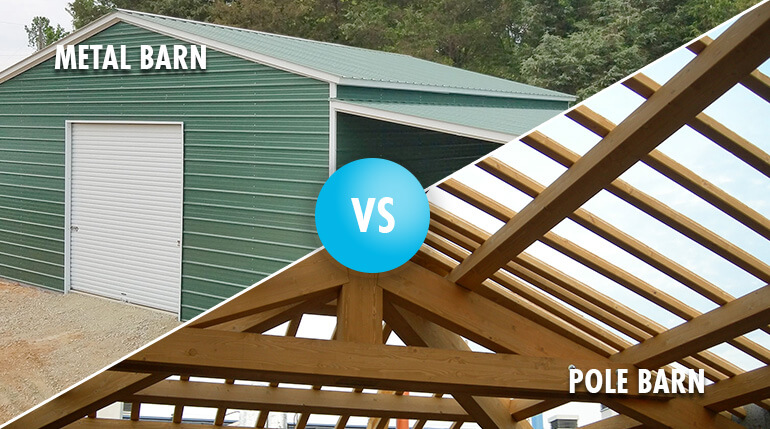
A pole barn (sometimes called post-frame construction) uses wooden poles or posts buried into the ground as the primary structural support. These poles carry the weight of the roof and walls. Pole barns typically have no concrete foundation — the buried poles serve as both foundation and structural support. The exterior is usually clad with metal panels or sometimes aluminum, with the poles spaced every 6 to 10 feet apart.
Pole barns have been the default rural barn for over a century because they’re relatively quick and cheap to build, especially on agricultural land where simple shelter is all you need.
What Is a Metal Barn?
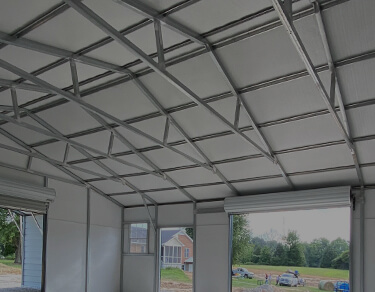
A metal barn (also called a steel barn) uses steel framing for the entire structure — both the support framing and the panels. The framing comes prefabricated and pre-cut, ready to assemble on your foundation. Metal barns typically sit on a concrete slab, gravel pad, or in some cases compacted ground with proper anchoring.
Metal barns have grown rapidly in popularity over the past two decades because manufacturing improvements have brought their cost down while their durability has stayed the same — or improved — over wood-based alternatives.
Side-by-Side Comparison: Metal Barn vs Pole Barn
Here’s how the two compare across the factors that matter most:
|
Factor |
Metal Barn |
Pole Barn |
|
Framing material |
Steel (consistent throughout) |
Wood poles + steel/aluminum panels |
|
Foundation |
Concrete slab, gravel, or anchored ground |
Wood poles buried directly in ground |
|
Typical lifespan |
50+ years |
25-40 years (with maintenance) |
|
Termite risk |
None (steel) |
Significant (wooden poles) |
|
Mold/rot risk |
Very low |
Moderate to high |
|
Maintenance need |
Minimal |
Significant (pole realignment every 5-10 yrs) |
|
Construction time |
Fast (days to weeks) |
Moderate (weeks) |
|
Strength/durability |
Consistent steel grade throughout |
Varies with wood quality |
|
Fire resistance |
Steel doesn’t burn |
Wood is flammable |
|
Pest resistance |
Excellent |
Vulnerable (insects, rodents) |
|
Upfront cost |
Moderate |
Often slightly lower |
|
Total lifetime cost |
Lower (less maintenance, longer life) |
Higher (repairs + replacement) |
|
Resale value |
Higher (longer warranty, durability) |
Lower (depreciates with wood) |
|
Customization |
High (sizes, colors, gauges, add-ons) |
Moderate (limited by structural design) |
|
Best for… |
Most modern builds, long-term use |
Tight-budget agricultural, traditional look |
The pattern is consistent: pole barns often win on upfront cost, but metal barns usually win on everything else — and almost always on total cost of ownership over the building’s lifetime.
6 Common Issues With Pole Barns
If you’re considering a pole barn, these are the issues you should know about upfront. Most pole barn owners run into at least one or two of these eventually, and they’re the main reasons many farmers and rural homeowners are switching to metal.
1. Rotting Columns
This is the number-one problem with pole barns, and it’s exactly what it sounds like. The wooden columns or posts buried in the ground are constantly exposed to moisture from the soil. Over the years, this moisture soaks into the wood like a sponge, leading to rot — especially when untreated lumber was used during construction.
Even pressure-treated lumber doesn’t fully solve the problem. It slows the rot but doesn’t eliminate it. Once the columns start rotting at ground level, the whole structure becomes compromised, and replacement is expensive and complicated.
With a metal barn, there are no wooden columns. The steel framing sits on a concrete or gravel foundation above ground, eliminating the rot problem entirely.
2. Termites and Mold
Any structure built with wood is vulnerable to termites and mold. Termites cause silent, slow damage that can compromise structural integrity over years before anyone notices. Mold thrives in the moist conditions inside damp wooden structures, particularly in humid climates.
Repairing termite or mold damage in a pole barn can cost thousands of dollars — and that’s after the labor cost of finding and accessing all the damaged areas, which are often hidden inside walls or below ground level. With a metal barn, both problems are eliminated by design. Steel doesn’t feed termites and doesn’t grow mold.
3. Dislodged Nails and Loose Staples
Pole barns are built using nails and staples to attach the metal or aluminum panels to the wooden frame. Over time, as the wood expands and contracts with temperature and moisture changes, these fasteners loosen and back out of the wood. The result: panels start to flap in wind, water leaks in around fastener holes, and the building’s integrity slowly degrades.
A metal or steel barn, by contrast, is built using high-strength bolts that thread into steel framing. The connection is mechanical and permanent — it doesn’t loosen with normal weather cycles, doesn’t allow water leaks around fasteners, and doesn’t lead to frame shifting, warping, or sagging the way nail-and-staple construction does.
4. Pole Barns Require Significantly More Maintenance
Once a pole barn is built, the maintenance clock starts. The wooden poles buried in the ground tend to shift over time as soil settles and the wood swells and contracts with seasons. Because of this, the foundation poles of a pole barn often have to be realigned and straightened every 5 to 10 years — work that can cost thousands of dollars in labor.
Add in the need to repaint wood exterior elements, replace damaged panels, deal with rust around dislodged fasteners, treat for pests, and repair rot, and you have a building that demands ongoing attention. Metal barns require almost none of this — periodic rinsing, gutter checks, and occasional touch-up paint is typically all that’s needed for decades.
5. Compromised Strength and Durability
The strength and durability of a wood pole barn simply doesn’t match a metal or steel building. Wooden beams and poles come from different pieces of wood — some pieces are stronger than others, even within the same batch. You get inconsistent strength throughout the structure.
Steel doesn’t vary structurally. Every piece of 14-gauge steel tubing is structurally identical to every other piece. That consistency means engineers can design for known load capacities, and the entire building performs predictably under wind, snow, and seismic stress. With wood, you’re working with biological variability that no engineering can fully account for.
6. Pole Barns Have a Shorter Useful Life
Add up the rot, termite risk, maintenance demands, and structural inconsistency, and pole barns simply don’t last as long as metal barns. A typical pole barn with good care lasts 25 to 40 years before major renovation or replacement is needed. A quality metal barn lasts 50 years or more with minimal maintenance, and many last well beyond that.
Over a 50-year ownership horizon, this lifespan difference often translates to thousands of dollars in long-term savings, despite metal barns sometimes costing more upfront.
When a Pole Barn Still Makes Sense
In the interest of giving you the honest answer rather than the salesy one, pole barns aren’t always the wrong choice. There are specific situations where a pole barn can be the right call:
Very Tight Budget for a Basic Agricultural Shelter
If you need the absolute lowest-cost shelter for hay, equipment, or livestock on agricultural land — and you’re not concerned about long-term durability or low maintenance — a basic pole barn can be cheaper upfront than a comparable metal barn. For rough storage on a farm where the building doesn’t need to last 50 years, this can be a defensible choice.
Traditional Rural Aesthetic
Some property owners specifically want the look of a traditional wooden barn. If aesthetics matter more to you than maintenance or lifespan, and you genuinely prefer the look of weathered wood and post-frame construction, a pole barn delivers that look in a way modern metal can’t fully replicate (though wood-look metal panels have come a long way).
Doing It Yourself With Available Lumber
If you have access to inexpensive lumber, sawmill access, or you’re an experienced builder who wants to construct the barn yourself, the DIY pole barn route can save significant money. Metal barn kits are designed for professional installation, so the DIY savings on a metal barn are typically smaller.
Short-Term Use Buildings
If you genuinely only need the barn for a few years (renting land, temporary operation, planned property sale), the lower upfront cost of a pole barn might not give the long-term maintenance issues time to become problems.
For everyone else — most homeowners, ranchers, small business owners, and anyone building for the long term — metal barns are the better-value choice.
Why Most Buyers Choose Metal Barns in 2026
If you’ve read this far, you can already see the pattern: metal barns win on durability, maintenance, lifespan, and total cost of ownership. Here’s a quick summary of why metal barns have become the default choice for most buyers in 2026:
- They last 50+ years with minimal maintenance
- They resist termites, rot, mold, and pests
- They’re faster to build than traditional construction
- They come with long manufacturer warranties (often 10-20+ years on the structure)
- They’re customizable in sizes, colors, gauges, doors, and add-ons
- They handle severe weather better than wood-based structures
- They hold their value at resale better than aging pole barns
- They offer financing and rent-to-own options that lower the upfront cost barrier
That last point matters more than people realize. The historical reason buyers chose pole barns over metal was simply the upfront cost. With modern financing and rent-to-own programs, that gap has narrowed dramatically — putting a quality metal barn within reach of nearly any budget.
Common Metal Barn Use Cases
Metal barns work for a wide range of purposes. Here are the most common ways our customers use them:
- Equipment storage: Tractors, ATVs, mowers, hay equipment, attachments — protected from weather and theft.
- Livestock shelter: Horses, cattle, goats, sheep, poultry — with options for stalls, ventilation, and feed storage.
- Hay and feed storage: Keeps hay dry and protected from pests, which is essential for nutritional value and feed safety.
- Workshops: Serious workspace with room for tools, benches, and equipment. Optional insulation makes year-round use comfortable.
- Vehicle and RV storage: Protect trucks, ATVs, boats, RV covers, and trailers from sun and weather.
- Barndominiums: Combination living-and-work space that’s grown rapidly in popularity. Mix of residential living quarters and traditional barn use.
- Commercial use: Small business shops, retail, or farm-to-table operations need durable space that doesn’t require constant upkeep.
Frequently Asked Questions
Is a metal barn better than a pole barn?
For most buyers, yes — a metal barn is the better choice. Metal barns last longer (50+ years vs 25-40 for pole barns), need significantly less maintenance, resist termites, rot, mold, and pests, and offer better long-term value despite sometimes costing slightly more upfront. Pole barns still make sense for very tight budgets, traditional rural aesthetics, DIY builds, or short-term use buildings.
How long does a metal barn last vs a pole barn?
A quality metal barn typically lasts 50 years or more with minimal maintenance. A well-built pole barn typically lasts 25 to 40 years and requires regular maintenance to reach the upper end of that range — including pole realignment, panel repairs, fastener replacement, and rot treatment. Over a 50-year ownership horizon, the lifespan difference often outweighs any upfront cost difference.
Are metal barns cheaper than pole barns?
Upfront, pole barns are often slightly cheaper, especially for very basic agricultural buildings. However, when you factor in long-term costs — pole realignment every 5-10 years, panel repairs, termite treatment, rot remediation, eventual replacement — metal barns are typically cheaper over the building’s lifetime. The cost gap has also narrowed significantly in recent years as metal manufacturing has improved.
Do pole barns really rot?
Yes, pole barns do rot — particularly at the base of the wooden poles where they meet the ground. This is the single most common pole barn problem. Pressure-treated lumber slows rot but doesn’t eliminate it, and even treated poles eventually rot at the ground line. Many pole barns require column replacement or jacking and resetting within 15-25 years.
Do metal barns rust?
Modern metal barns are coated with rust-resistant finishes (typically galvanized or painted with multi-decade-rated coatings) that significantly resist rust. Most quality metal barns come with rust-through warranties of 10-20 years or longer. Small surface rust on scratched areas can be touched up easily, and properly maintained metal barns hold up extremely well even in humid or coastal environments.
Can a metal barn be built without a foundation?
Yes, smaller metal barns can be installed on gravel pads, compacted ground, or with ground anchors — particularly for agricultural and storage use. For larger buildings, residential use, or permitted structures, a concrete slab is recommended and often required. The foundation choice affects cost, durability, and which anchoring system can be used.
Do metal barns require permits?
Most metal barns require building permits, especially for larger sizes or permanent structures. Permit requirements vary by city, county, and state. Smaller agricultural buildings on rural land sometimes have lighter permitting requirements. Always check with your local building department before ordering. A reputable dealer can provide the certified engineering drawings you’ll need.
Are metal barns good for livestock?
Yes, metal barns are excellent for livestock when properly designed. Add ventilation (essential), interior stalls or pens as needed, and proper drainage on the foundation. The main advantage for livestock use is that metal doesn’t harbor parasites the way wood can, and it’s far easier to power-wash and disinfect. Many horse and cattle operations have switched to metal for these reasons.
Can I get a metal barn with no credit check?
Yes, rent-to-own programs let you get a metal barn with no credit check. You make a small first-month payment, take delivery, and pay monthly until you own it. This makes metal barns accessible to buyers with limited or poor credit, and it requires significantly less upfront money than traditional purchases.
How long does it take to build a metal barn?
After delivery, professional installation of a typical metal barn takes a few days to a couple of weeks depending on size and customization. Manufacturing usually takes a few weeks beforehand. The full timeline from order to finished building is typically 4-10 weeks — much faster than a comparable pole barn or traditional construction.
The Bottom Line
If you’re choosing between a metal barn and a pole barn in 2026, the math usually favors metal. Longer lifespan, lower maintenance, better pest and weather resistance, and improving cost competitiveness make metal the smarter long-term investment for most buyers.
Pole barns aren’t gone — they still make sense for specific situations like very tight budgets, traditional aesthetic preferences, or short-term agricultural use. But for anyone building a barn they want to last for the next 30 to 50 years, metal is almost always the better call.
At Bulldog Steel Structures, we offer a full range of metal barns in sizes from small livestock shelters to large multi-use commercial buildings. We also offer financing options and rent-to-own programs with no credit check to make the right barn affordable for any budget.
Have questions about metal barns or want to talk through your specific needs? Contact us today and our team will help you find the right barn for your property, budget, and use case.
Do you have questions about metal barns? Contact us today.
delivering & installing
throughout
the united states
Bulldog’s metal barns, garages, and carports are available for delivery and installation in most of the U.S. Whether you’re a homeowner in Maine, a rancher in Texas, or a small business owner in California, you’ll get to-your-door delivery and professional installation, so your building will be sturdy and reliable for years to come.
See Service Area